.png)
The Benefits of Using Essential Assessment in the Early Years
Practical approaches to using Essential Assessment in F-2 classrooms.
Introduction
In the early years, assessment must be developmentally appropriate, highly scaffolded and embedded within explicit teaching. Rather than viewing assessment as an endpoint, it should be seen as part of the learning process itself—supporting observation, interaction and responsive teaching.
This approach aligns with the Early Years Learning Framework (EYLF) v2.0, where intentional teaching and guided learning experiences are central to supporting young learners.
Essential Assessment is a curriculum-aligned assessment tool catering to Foundation to Year 10 students. When used thoughtfully in the early years, it can support both student agency and teacher insight, while remaining aligned with how young students learn best.
Benefit 1: Building early digital capability through purposeful use
Foundation students are increasingly familiar with digital devices. As part of the Australian Curriculum, students are expected to begin engaging with digital systems in meaningful ways.
The Australian Curriculum: Digital Technologies (AC9TDIFK01) outlines that by the end of Foundation, students should:
- recognise and explore digital systems for a purpose.
- identify technologies used in home and school environments.
Using Essential Assessment provides an authentic context for this learning. Through explicit teaching, students develop foundational skills such as:
- logging in using a QR code
- navigating a keyboard
- selecting and dragging items
- listening to text via audio support
- moving between questions
- reviewing responses
These are not assumed skills—they are explicitly taught, modelled and practised, aligning with effective early years pedagogy.
Benefit 2: Developing assessment-capable learners from the start
When students are included in the assessment process, they begin to understand:
- what they are learning
- how they are progressing
- what to do next
This aligns with the work of John Hattie and the concept of Assessment Capable Learners.
“I can” statements, visual supports and structured routines allow students to:
- build confidence
- engage with feedback
- develop a sense of ownership over their learning
Importantly, early exposure is not about preparing for high-stakes testing, but about reducing cognitive load.
As Carl Hendrick highlights, novice learners require structured support. By explicitly teaching how to navigate the platform, we remove unnecessary barriers, allowing students to focus on the learning itself rather than the mechanics of the task.
Benefit 3: Supporting teacher insight and responsive instruction
In the early years, assessment is most powerful when it informs teaching.
Essential Assessment provides early, curriculum-aligned insight into:
- what students can demonstrate
- emerging misunderstandings
- readiness for next steps
This supports a data-informed approach to teaching, where educators can adjust instruction, revisit prerequisite skills and respond to student needs in real time.
Importantly, in Foundation, the use of Essential Assessment should be initially viewed as a guided learning experience, and then gradually lead to students being able to log in and complete an assessment independently. This reduces the need for intensive one-to-one assessment procedures.
How to begin the Essential Assessment journey in Foundation-Y2
A gradual, scaffolded approach is key.
Recommended starting points include:
- Orientation sessions- Explicitly teach each component of the platform. Using Teacher-led support mode to model how to navigate and respond to assessment questions
- Use the student portal to ensure students understand how to interact with the tool and navigate the platform
- Use My Numeracy and My Literacy for Daily Review/ Skill Building Episodes using mini-whiteboards and no devices
- Consider administering a paper-based assessment for initial data collection
Consider creating a flexi assessment with specific content rather than the General All/ NSW Common Grade when students can complete independently.
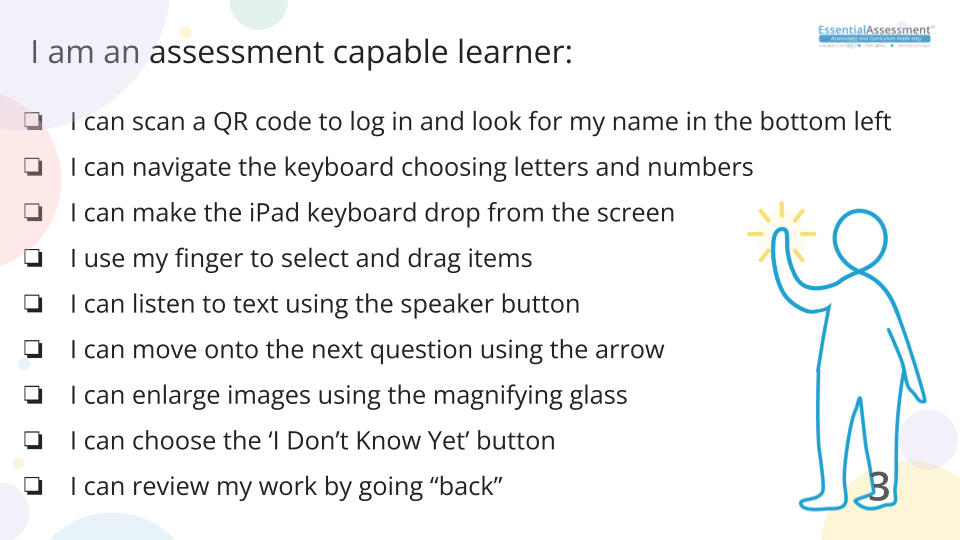
👉 This visual supports the explicit teaching of digital and assessment behaviours.
Using “I Can” statements to build capability
“I can” statements provide a clear, student-friendly way to develop independence over time.
Examples include:
- I can scan a QR code to log in
- I can listen to text using the speaker button
- I can move to the next question
- I can choose “I don’t know yet”
- I can review my work
These statements support both metacognition and confidence building.
They also align with growth mindset principles, reinforcing that learning is a process.
👉 This reinforces student agency and provides a consistent classroom reference point.
A note on cognitive load and early learners
For young learners, managing cognitive load is critical.
As highlighted by Nathaniel Swain, knowledge and procedural fluency reduce the mental effort required to engage with new learning.
In this context:
- navigation skills must become automatic
- routines must be predictable
- support must be gradual
This ensures that assessment remains focused on learning, not logistics.
Testimonial From an Early Years Classroom Teacher
“Thank you for opening my eyes further to the possibilities for Essential Assessment (EA) as a tool to ‘sit beside’ my Prep students when assessing. It gives me valuable information to inform my planning and teaching, knowing where to take my five-year-olds next! EA allows me to look across the curriculum and teach ICT processes at the same time. It was great to have your personable approach, face to face, committed to our school and my professional development.”
Mrs Gill Davey, Epsom Primary School (VIC)
Summary
Essential Assessment can be effectively used in the early years when implemented through:
- explicit teaching
- scaffolded support
- short, purposeful experiences
Essential Assessment supports digital capability, student agency and data-informed teaching.
Like all foundational skills in the early years, using an assessment platform is not innate—it must be carefully taught, modelled and embedded over time.
When this occurs, assessment truly begins to sit beside learning, supporting both the student and the teacher in understanding what comes next.
References
Absolum, M., Flockton, L., Hattie, J., Hipkins, R., & Reid, I. (2009). Directions for assessment in New Zealand (DANZ). Ministry of Education.
Australian Curriculum, Assessment and Reporting Authority (ACARA). (2022). Australian Curriculum v9.0 – Digital Technologies. https://v9.australiancurriculum.edu.au
Australian Government Department of Education. (2022). Early Years Learning Framework (EYLF) v2.0.
Frey, N., Fisher, D., & Hattie, J. (2018). Developing assessment-capable learners. Educational Leadership, 75(5).
Hendrick, C., & Macpherson, R. (2017). What does this look like in the classroom? John Catt.
Swain, N. (2021). Harnessing the science of learning: Success stories to help kickstart your school improvement.
Australian Education Research Organisation (AERO). (2023). Explicit instruction and effective teaching practices.