.png)
Making Sense of the NSW Common Grade Assessments in Essential Assessment
Overview
Essential Assessment’s NSW Common Grade Assessments are a suite of four stage-based assessments designed to support strategic, curriculum-aligned teaching and learning across K–10. They include:
- One for each of the three Mathematics strands (Number and Algebra, Measurement and Space, Statistics and Probability)
- One for English
These assessments are best viewed as 'book-end' assessments, offering a broad snapshot of student learning across a stage at three key points in the year:
- Pre-assessment – Start of the year
- Mid-assessment – Prior to mid-year reporting
- Post-assessment – Prior to end-of-year reporting
They are not designed to assess every detail of a student’s learning, but to offer a high-level view across content groups. This supports educators in identifying where to dive deeper and where further investigation or intervention may be required.
Purposeful Timing and Use
There is no requirement for these assessments to be completed within an extremely short time frame (e.g. a single week).
Instead, schools are encouraged to administer them with purpose, flexibility, and alignment to their teaching sequence.
For example:
- During Term 1, as students will be exposed to content in each of the three Mathematics strands and English, teachers may complete the Common Grade assessments approximately 1–2 weeks before commencing teaching to gain meaningful insight into student understanding.
- Mid-year (mid) and end-of-year (post) assessments do not need to be completed all at once. Rather, they can be offered progressively, strand by strand, depending on when content has been explicitly taught.
This staged approach supports:
- Better alignment with the timing of instruction
- Reduced cognitive load for students
- Greater accuracy in identifying retained knowledge and instructional impact
By collecting data in a timely and purposeful way, educators can ensure that assessment results are relevant, reliable, and ready to inform the next steps in teaching and learning.
Best-Fit Allocation and Dynamic Function
We strongly recommend that students are not assigned an assessment range based on their enrolled year level. Instead, we encourage teachers to manually assign a "best-fit" stage for each student, informed by their understanding of the student’s Zone of Proximal Development (ZPD).
This 'best-fit' assignment activates the dynamic function (for the pre-assessment only), allowing the platform to automatically shift questions up or down by one stage based on student responses.
This:
- Ensures students are appropriately challenged
- Supports accurate diagnosis of conceptual understanding
- Promotes positive assessment experiences for all learners
Proximal vs Distal Assessment: A Balanced Approach
The NSW Common Grade Assessments function as distal assessments, spaced in time from the moment of instruction. They can offer insight into what students can retrieve and apply after a period of time has passed — a more accurate reflection of retained learning.
These are best used in combination with proximal assessments, such as:
- Flexi Assessments aligned to the Diocesan Units of Work
- Check-for-understanding tasks and formative tasks following explicit instruction (My Numeracy)
Used together, proximal and distal assessments offer:
- Immediate feedback on recent instruction
- Long-term insight into what has been truly learned and retained
- A holistic picture of both performance and progress
Insights for All Stakeholders
Common Grade assessments are valuable for:
- Teachers: Target next steps, differentiate instruction, and monitor growth.
- Leaders: Benchmark cohort performance, track whole-school trends, and allocate resources.
- Students: To understand their learning goals and progress over time.
- Parents: See clear evidence of curriculum-linked growth.
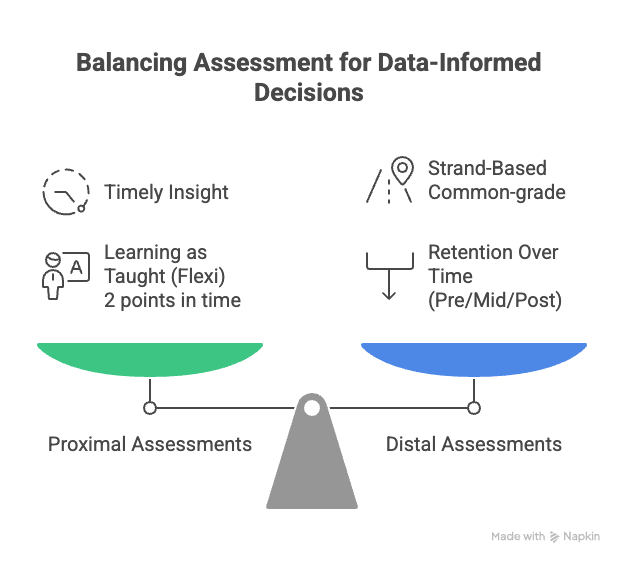
Proximal assessments (including Flexi Assessments, check-for-understanding tasks, and formative routines) are valuable for:
-
Teachers:
Confirm understanding during and immediately after instruction, adjust teaching in real time, and respond quickly to misconceptions or gaps.
-
Leaders:
Build visibility of instructional consistency, monitor the impact of teaching approaches across classrooms, and support targeted professional learning.
-
Students:
Receive timely feedback, develop clarity around success criteria, and understand what they know — and what they are still working towards.
-
Parents and carers:
Gain insight into how learning is progressing throughout the teaching cycle, not just at reporting points.
Together, proximal and distal assessments play complementary roles. Proximal assessments provide timely insight into learning as it is being taught, while distal assessments offer a light-touch, strand-based overview of what has been retained over time.
Used in combination, the NSW Common Grade Assessments can support data-informed decision-making that strengthens classroom practice, guides strategic leadership, and benefits the entire learning community.